How to Use Medium to Rank Quickly for Competitive Keywords
Ranking for competitive keywords on Google is difficult, but Medium.com offers a shortcut thanks to its high Domain Rating (DR) of 94. This SEO boost allows content to rank quickly, even for highly competitive terms. However, this strategy raises questions about long-term sustainability, especially

Ranking for competitive keywords on Google is difficult, but Medium.com offers a shortcut thanks to its high Domain Rating (DR) of 94. This SEO boost allows content to rank quickly, even for highly competitive terms. However, this strategy raises questions about long-term sustainability, especially when the author lacks traditional EEAT (Experience, Expertise, Authoritativeness, Trustworthiness) signals.
This post focuses on how certain users have managed to rank for competitive keywords despite minimal EEAT factors—such as inactive LinkedIn profiles or expired personal websites—by leveraging Medium’s domain strength.
Why Medium?
Medium’s high DR enables content to rank more easily than on smaller or newer domains. For some users, this provides a way to bypass the usual challenges of building domain authority from scratch. The platform’s key advantages include:
- High Domain Authority: Medium’s strong DR allows content to rank faster and higher on search engines.
- Traffic Potential: Even without personal authority or a robust web presence, Medium’s domain strength can still drive significant organic traffic.
- SEO-Friendly Features: Medium’s built-in SEO tools—such as tags, internal linking, and a clean structure—assist in fast indexing and ranking.
Example: A High-Ranking Strategy with Minimal EEAT
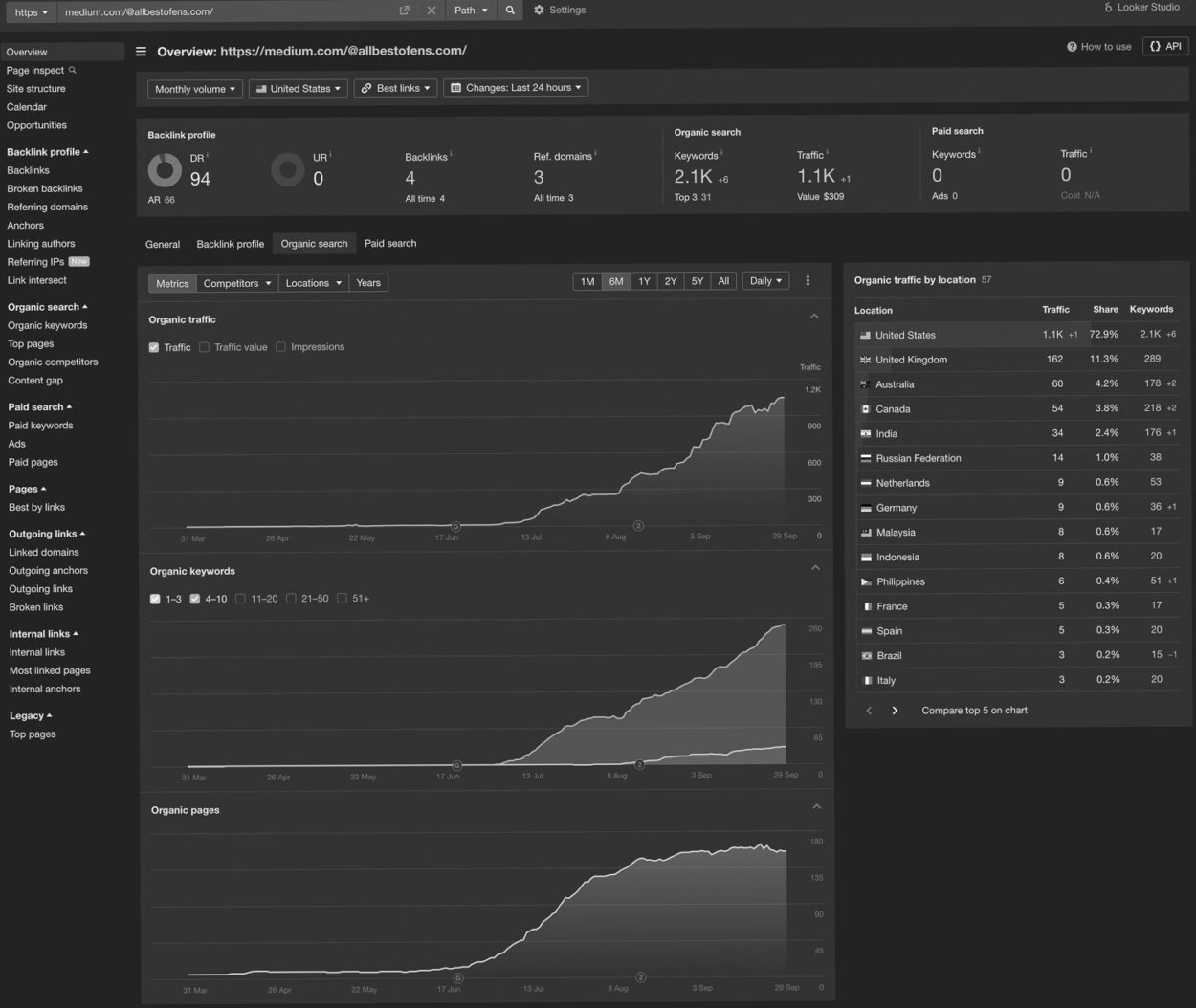
Ahrefs screenshot illustrating the rapid growth in organic traffic and keyword rankings for a Medium.com article over the last six months. This highlights the potential of Medium’s high domain authority to rank quickly for competitive keywords, as discussed in the blog post.
Despite lacking a robust personal web presence, one user achieved significant keyword rankings by leveraging Medium’s platform:
- Best camera for sports photography beginner – Ranked 4th, with 600 monthly searches.
- Best camera for social media – Ranked 3rd, with 300 monthly searches.
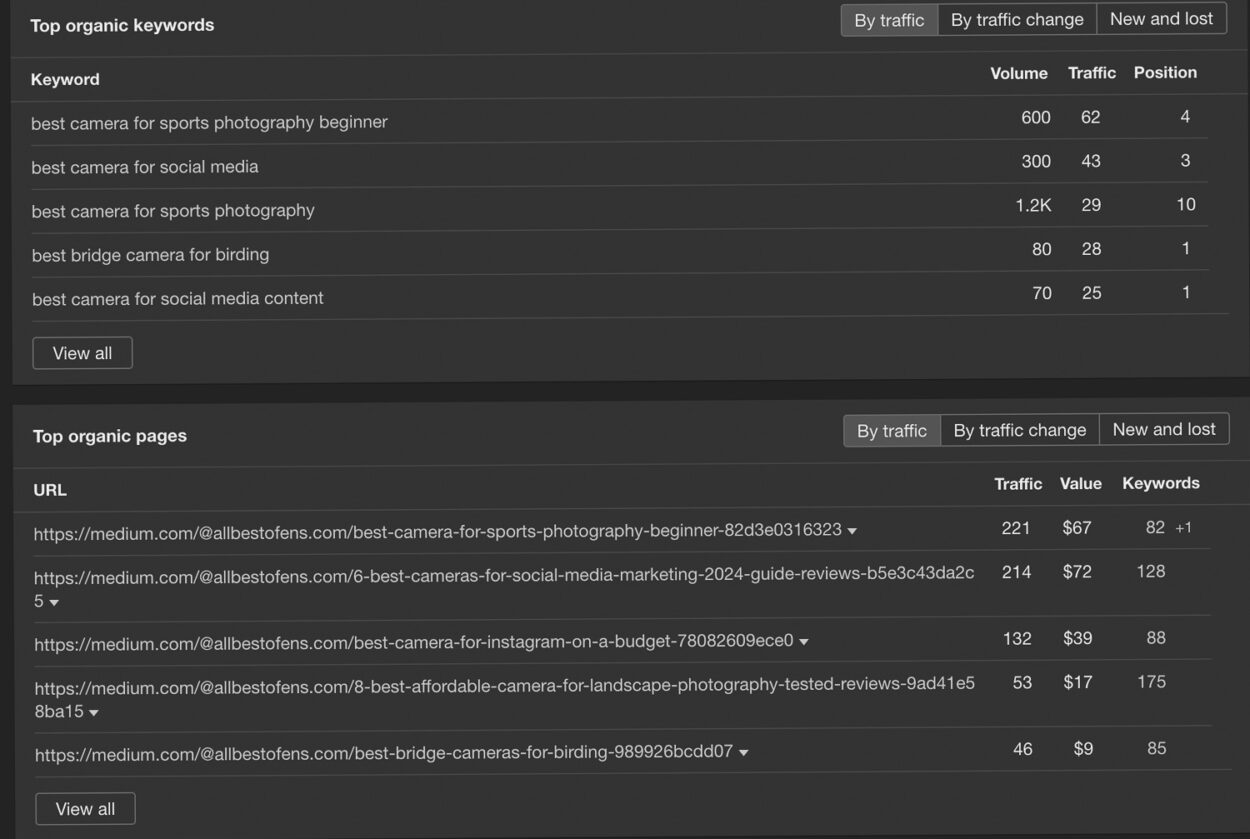
Ahrefs data highlighting the top organic keywords and pages for a Medium.com publication. The site ranks highly for competitive keywords such as ‘best camera for sports photography beginner’ and ‘best bridge camera for birding,’ showcasing the platform’s capability to achieve strong SEO performance even in highly contested niches.
These results show that even without a personal EEAT foundation, Medium’s domain strength can enable articles to compete with established photography sites, simply by hosting the content on the platform.
Key Insights from Ahrefs Data
The Ahrefs data reveals the power of Medium’s domain authority for individuals leveraging the platform:
- Over 2,100 Keywords Ranked: The user’s Medium profile ranks for thousands of keywords, driving over 1.1K organic visitors per month.
- Competing with Established Sites: Despite minimal online credibility, the content competes with industry-specific websites like Digital Camera World, thanks entirely to Medium’s high DR.
- Lack of EEAT: Although the user has minimal online credibility (e.g., inactive LinkedIn or expired personal domain), Medium’s domain strength keeps the rankings intact.
How to Use Medium for Ranking Competitive Keywords
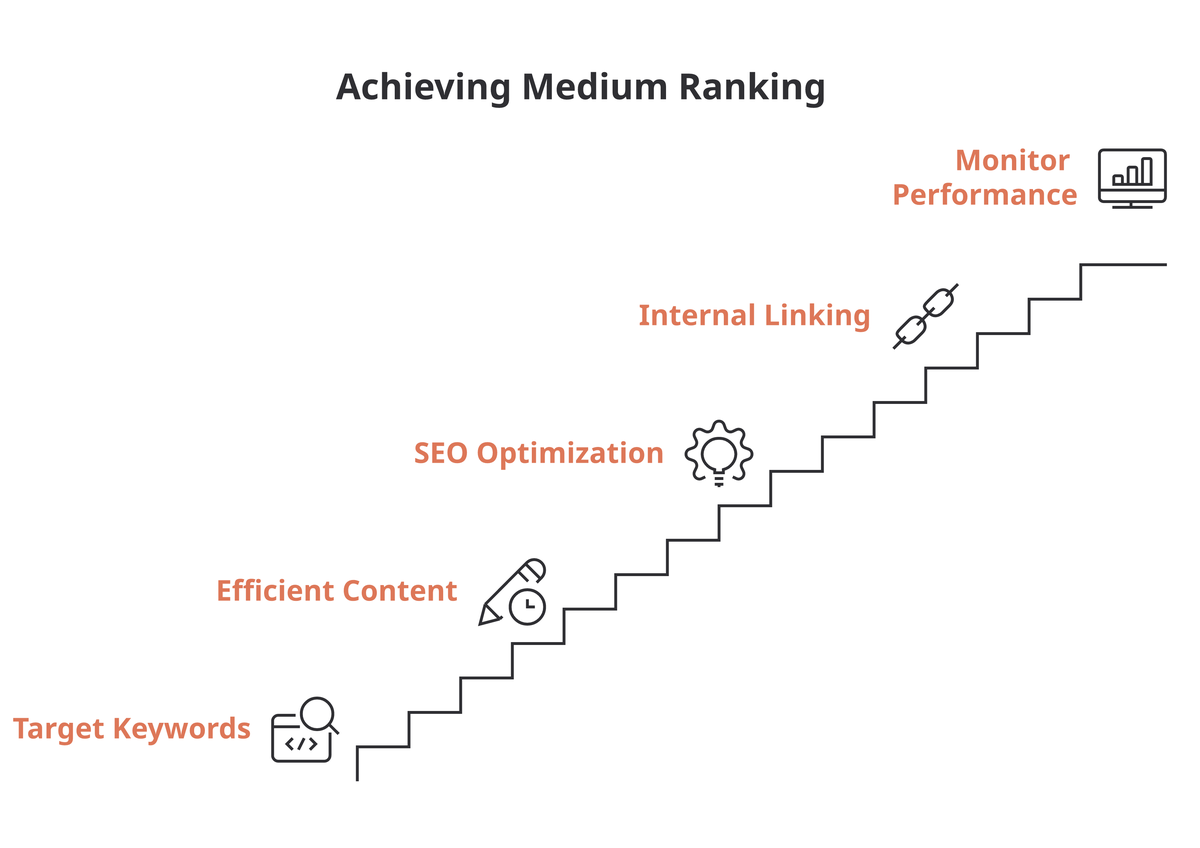
If you want to rank for competitive keywords using Medium, here’s what you should do:
- Focus on High-Volume Keywords: Use tools like Ahrefs to find competitive keywords that would be difficult to rank for on your own domain.
- Generate Content Efficiently: While creating high-quality, valuable content is ideal, even low-quality, AI-generated content can perform well on Medium due to its domain authority. However, relying on low-effort content may not be sustainable if Google further prioritizes EEAT in the future.
- Optimize for SEO: Ensure your title, meta description, and headers are keyword-optimized. Take advantage of Medium’s tagging system for better visibility.
- Use Internal Linking: Link to other relevant articles on Medium to strengthen your SEO performance and increase content authority.
- Monitor Performance: Use Medium’s built-in analytics tools to track your article’s views, reads, and referrers. For deeper keyword tracking and performance on search engines, rely on third-party tools like Ahrefs or SEMrush, as Medium does not support external tracking with Google Search Console or Google Analytics.
Long-Term Sustainability: The EEAT Challenge
While this case study highlights Medium’s potential for quick rankings, it also underscores the risks of relying solely on platform authority. Google’s emphasis on EEAT is growing, and future algorithm updates could penalize users who lack personal expertise or credibility. If Google begins prioritizing individual authority over platform authority, Medium-based rankings like these could suffer, especially for low-quality or AI-generated content.
My Take: What This Means for Solo Publishers
The Medium play still works — the Ahrefs data in this post is real, and the rankings are legitimate. But the window is narrowing. Google’s December 2025 core update significantly improved its ability to distinguish genuine expertise from content borrowing platform authority. Medium is the classic parasite SEO move: borrow a DR 94 host, rank fast, collect traffic. It’s a real tactic — until Google tightens the screws further on third-party platform authority.
Here’s what I’d actually implement for affiliate content today. Use Medium as a bridge, not a destination. Write a solid piece on Medium targeting a keyword your own site can’t compete on yet, then point the Medium article to your affiliate-optimized landing page. You capture the ranking; readers still land where you want them. Pair that with a minimal EEAT footprint: a verified LinkedIn, a couple of bylines on niche sites. Tom Winter’s LLM-based EEAT auditing framework lays out exactly which signals Google evaluates — a thin but consistent author trail beats zero presence every time.
What to ignore: the Medium Partner Program monetization angle. As an affiliate marketer you don’t care about their $5-per-read revenue split — you care about the ranking signal. Treat Medium as a keyword wedge while you build domain authority on your own properties. This is the core idea behind the traffic diversification playbook: own multiple channels so a single algorithm shift can’t wipe out your income overnight.
The EEAT sustainability concern in this post is real but slightly overstated for affiliate publishers. EEAT risk is highest in YMYL categories — health, finance, legal. Camera gear and photography sit in a much lower-risk zone. That said, the broader trend is clear: LLM-driven search is reshaping how content gets discovered, and when AI-generated results dominate SERPs, platform authority matters less than topical depth. Use Medium while it works, and use the traffic it sends to build the asset that actually lasts.
The AI-Era Angle: Borrowed Authority Buys Retrieval, Not a Byline
The Medium play is the classic parasite move: rent a DR-94 host, rank a page you couldn’t rank on your own domain, collect the click. The whole tactic is built on one assumption — that the prize is a blue link the reader actually clicks. When the SERP turns into an AI Overview or an answer-engine response, that assumption quietly breaks, and the parasite play breaks in a way that’s worth being precise about.
Start with what survives. Medium content is heavily represented in LLM training data and is exactly the kind of clean, well-structured page that RAG retrievers pull into a generated answer. So borrowed authority still buys you something: a retrieval surface. A solid Medium piece can absolutely get lifted into a ChatGPT or Perplexity answer, the same way it gets indexed by Google. The host’s strength still helps you get found by the engine.
What doesn’t survive is the part you actually monetize. Parasite SEO was always a trade — you give up the byline (the URL is medium.com/@you, not your domain) in exchange for the ranking. In the ten-blue-links era that trade paid off, because the click landed on your article and you controlled the page: your affiliate links, your CTA, your bridge to a landing page. In an AI answer there’s no page to control. The engine extracts the fact, attributes it to “Medium” or a bare source chip, and the reader never lands anywhere. You rented authority to win a retrieval slot whose payout — the click, the link, the byline — has been stripped out. The entity that the answer engine remembers is Medium, not you.
That’s the real shift for this tactic: parasite SEO degrades from a traffic play into, at best, a brand-impression play you can’t even claim, because your name isn’t on the citation. The durable version of the move inverts the same logic the diversification playbook argues for. Use Medium as a wedge to get retrieved and to seed the entity associations (your name, your niche, your other properties) into the model’s view of the topic — but build the citable, attributable asset on a property you own, where a retrieval slot can still convert into a click, a subscriber, or a sale. Borrowed authority is fine for getting into the answer. It’s useless for being the source the answer credits.
Conclusion
Medium.com offers a fast way to rank for competitive keywords, as demonstrated by this user’s success. However, this strategy may not be sustainable in the long term, especially with Google increasingly focusing on EEAT. While Medium’s authority can help you rank quickly, building your own expertise and online credibility will provide more lasting benefits.
To make Medium a more sustainable and profitable strategy, consider applying to its Partner Program, which rewards high-quality content with monetary compensation. For more information on how to succeed in Medium’s Partner Program, check out our guide on optimizing earnings through Medium’s Partner Program.