Nathan Gotch’s Innovative SEO Techniques for Boosting Rankings and Traffic
Introduction In a highly informative YouTube video, Nathan Gotch shares five advanced SEO techniques aimed at improving website rankings and traffic. This blog post distills his insights into clear, actionable strategies for SEO enthusiasts and professionals. The Merger Technique: Boosting Site Auth

Introduction
In a highly informative YouTube video, Nathan Gotch shares five advanced SEO techniques aimed at improving website rankings and traffic. This blog post distills his insights into clear, actionable strategies for SEO enthusiasts and professionals.
The Merger Technique: Boosting Site Authority
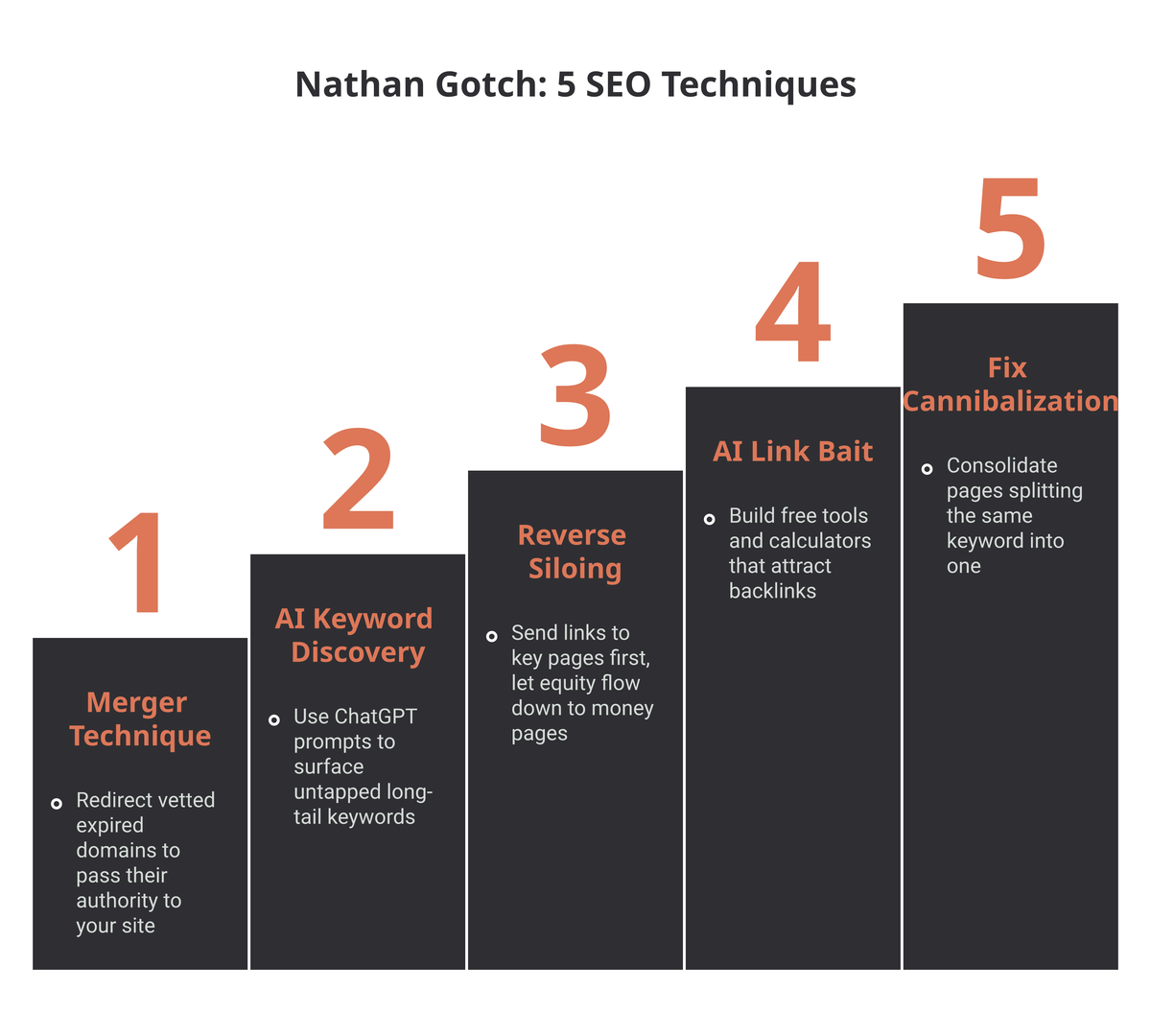
Gotch begins with the merger technique, which involves acquiring expired domains that have quality backlinks and redirecting them to your site. This method can significantly increase your site’s authority and rankings. Key steps include using specialized tools to find suitable expired domains and conducting a thorough vetting process for their relevance, link quality, and historical background before implementing strategic redirections.
Leveraging AI for Uncovering New Content Opportunities
The second technique Gotch discusses utilizes AI, particularly ChatGPT prompts, to identify untapped long-tail keywords with suboptimal rankings. These keywords present golden opportunities to create new, optimized content, filling gaps in your SEO strategy.
Reverse Siloing for Enhanced Site Authority
Gotch’s third technique, reverse siloing, is about strategically directing backlinks to certain key pages first. This approach boosts the overall site authority, subsequently aiding in the ranking improvement of other important pages like category and product pages.
Building Quick Link Bait Assets with AI
The fourth strategy involves using ChatGPT to quickly create link bait assets, such as free tools or calculators. By analyzing what has worked for competitors, these AI-generated assets can effectively attract valuable backlinks to your site.
Fixing Keyword Cannibalization
Lastly, Gotch addresses the issue of keyword cannibalization, where multiple pages target the same keyword, leading to ranking volatility. This problem is identified by observing changes in ranking URLs in the Search Console. The solution involves consolidating and correctly targeting each keyword to a unique intent, ensuring more effective SEO.
My Take: What This Means for Solo Publishers
Gotch’s five techniques are solid, but as a solo publisher or affiliate operator you can’t treat them equally. Some are worth doing this week. Others are theory-crafting for people with teams.
Start with keyword cannibalization. Of everything on this list, it’s the most immediately actionable and the fastest to pay off. Open Search Console, look for queries where the ranking URL keeps alternating between two pages month over month — that’s your signal. Fix it by consolidating or canonicalizing. Google typically responds within weeks. If you’re running any kind of systematic content reoptimization program, cannibalization cleanup should be your first pass before touching anything else.
The AI keyword discovery play is real, but update the workflow. ChatGPT prompts for long-tail gaps work — but in 2026 the smarter move is cross-referencing AI suggestions against Search Console queries that already have impressions but low clicks. Those are pages Google trusts enough to surface, just not rank yet. Much shorter path to traffic than new content. For affiliate sites specifically, pairing AI discovery with commercial-intent signals is where the real wins are hiding.
The merger technique (expired domain redirects) is the most underrated move here — but also the most expensive to get wrong. Relevance matters far more than raw DR. A beauty blog’s backlinks pointing at your photography site are mostly noise. Before spending money on domains, make sure you actually know what a quality backlink looks like. The Google API leak gave us useful signals about what link attributes Google actually weighs — worth understanding before you start buying domains.
Reverse siloing is worth doing, but don’t overcomplicate it. For most solo sites it just means: get links to your best content, then let internal linking carry the equity down to your money pages. The elaborate funnels are for agencies with 40 client sites. You’re not that.
What I’d skip for now: link bait assets. Building free tools to attract backlinks is smart in theory, but without real distribution muscle the tool just sits there. Get the other four working first.
The AI-Era Angle: AI as the Tool vs. AI as the Judge
This list is quietly an AI playbook — two of the five techniques (keyword discovery, link bait) run on ChatGPT. But notice what AI is doing in Gotch’s framing: it’s a production tool that helps you win the old ranking game faster. The shift since this video is that the same models are now also the judge — the answer engine deciding whether your page gets lifted into a response at all. Once you separate those two roles, the five techniques re-sort by how well they survive the move from ranking to getting cited.
Run them through that filter:
- Keyword cannibalization survives best — and the AI era raises the stakes. Two pages splitting a query don’t just trade ranking volatility now; they give a retriever two half-authoritative passages to choose from instead of one clearly-best source, which is exactly the kind of fuzzy signal that gets a site skipped in favor of a cleaner competitor. Consolidating to one strong page on each intent is GEO hygiene, not just SEO hygiene.
- The merger technique is an entity/authority play in disguise. Expired-domain redirects feed the same trust and link signals answer engines weigh when they pick whom to cite — but the relevance caveat gets sharper, not softer. A retriever reasoning about a central entity is unforgiving about topical mismatch, so off-topic borrowed authority is more likely to be ignored than to launder rank.
- Reverse siloing is just internal linking that concentrates equity on your pillar pages — and pillars are the unit answer engines reason over. The same plumbing that pushes a money page up the SERP also tells a model which of your pages is the canonical source on a topic.
- AI keyword discovery is where the workflow flips hardest. Gotch’s prompt finds gaps to rank; the AI-era version finds questions to answer extractably — the literal phrasings people type into ChatGPT and Perplexity, then content built to be lifted verbatim. Same tool, inverted target.
- Link bait changes least in theory and most in outcome: a genuinely useful free tool still earns links, but its bigger payoff now is becoming the thing a model retrieves and names when someone asks for “a calculator that does X.”
None of the five techniques die in the AI era. But the win condition underneath them quietly moved from rank #1 to be the source that gets cited — and a couple of them (cannibalization, AI discovery) are worth more effort once you measure them that way, not less.
Action Items for SEO Improvement
Following Nathan Gotch’s expert advice, here are essential action steps:
- Explore Merger Opportunities: Use tools to identify and vet quality expired domains for potential acquisition and redirection.
- Utilize ChatGPT for Keyword Discovery: Create prompts to unearth new long-tail keywords with room for ranking improvement.
- Apply Reverse Siloing: Drive links to select pages initially to enhance your site’s overall authority.
- Generate Link Bait Assets with AI: Use AI to analyze competitors and swiftly develop assets that can draw backlinks.
- Audit for Keyword Cannibalization: Regularly check your site for keyword cannibalization issues and address them by proper keyword consolidation.
Conclusion
Nathan Gotch’s video provides a valuable blueprint for anyone looking to elevate their website’s SEO performance. By incorporating these innovative techniques, you can enhance your site’s rankings, unlock new traffic opportunities, and effectively leverage AI in your SEO endeavors.

Watch “5 SEO Techniques” on YouTube