Olesia Korobka’s Insights on Next-Gen SEO with Ontology
Introduction In her insightful presentation titled “Next-Gen SEO: Unlocking the Untapped Potential of Ontology,” Olesia Korobka delved into advanced SEO techniques, focusing on building taxonomy, ontology, and knowledge graphs. This blog post will provide a perspective based on her presentation and

Introduction
In her insightful presentation titled “Next-Gen SEO: Unlocking the Untapped Potential of Ontology,” Olesia Korobka delved into advanced SEO techniques, focusing on building taxonomy, ontology, and knowledge graphs. This blog post will provide a perspective based on her presentation and slides, making it a valuable read for those eager to elevate their SEO strategies.
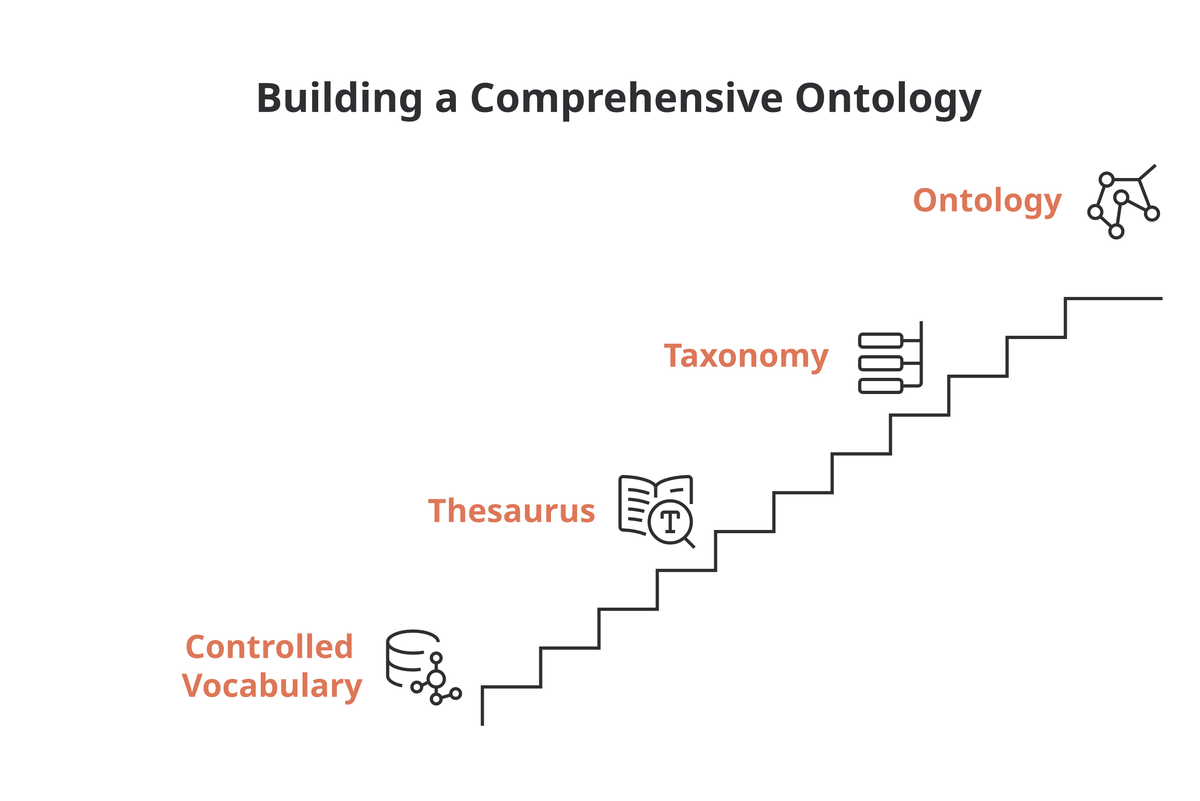
Controlled Vocabulary: The Foundation of Ontology
Korobka began by emphasizing the importance of controlled vocabularies – standardized industry terms that form the basis of effective SEO practices. She advised sourcing these from reputable platforms like Schema.org and Wikipedia, as well as scraping competitors and analyzing user queries.
Thesaurus: Tagging Concepts for Clarity
A thesaurus goes beyond basic vocabulary, offering synonyms and usage examples. This is invaluable for disambiguating terms, ensuring that content is precise and relevant.
Taxonomy: Hierarchical Organization of Concepts
Taxonomy, as explained by Korobka, is like a family tree for words, often presented in a parent-child relationship. This hierarchy not only structures site content but also forms the basis for website architecture.
Ontology: The Universe of Your Niche
Ontology builds upon taxonomy and controlled vocabularies, incorporating all their relationships and characteristics. It defines a ‘universe’ for your niche, transforming parent terms from taxonomy into classes in ontology.
RDF Vocabularies and LOV
Korobka highlighted RDF (Resource Description Framework) vocabularies like Dublin Core, SKOS, and FOAF as crucial tools. She suggested using LOV (Linked Open Vocabularies) for finding controlled vocabularies, advocating for RDF to connect data across the web using W3C standards and linked data.
Building Ontology: Tools and Techniques
When building ontology, Korobka recommended tools such as Protégé (free but complex) and OntoSpy (free, Python-based). She also mentioned WebVowl for visualization purposes.
Organizing Knowledge Base and Creating Content Templates
The process of creating a knowledge base involves collecting and storing data like titles, tags, body text, links, and other metadata. Korobka suggested using this organized knowledge to create content templates, optimizing for specific queries and topics.
Results, Performance Control, and Debugging
Korobka noted that the results of this methodology depend on the competitiveness of associated queries. For less competitive queries, expect to rank within two weeks. She also stressed the importance of performance control and debugging in this process.
My Take: What This Means for Solo Publishers
Ontology sounds like a graduate seminar project, and for most solo publishers it still is. But the landscape has shifted enough since Korobka’s presentation that at least part of her framework is now genuinely actionable — without a data science team.
Here’s what’s changed: in 2025–26, knowledge graphs stopped being a “future thing” and became a core component of how AI models retrieve and rank content. Industry analysts are now explicit — without semantic enrichment, AI architectures can’t reduce hallucinations, so content that’s topic-adjacent but structurally vague gets deprioritized. If you’ve read the Context Density framework here on RankingHacks, this connects directly: ontology is how you build context density at scale, before you even write a word.
For a solo affiliate publisher, the full Protégé-based ontology build is overkill. But three parts of Korobka’s stack are worth pulling out right now:
Controlled vocabulary first. Before you write anything in a cluster, spend 30 minutes in Schema.org and Wikipedia pinning down the canonical terms. This shapes your H2 structure and internal link anchor text — which is exactly where LLM-driven SEO signal propagates through your topical cluster.
Taxonomy as site architecture. The parent-child concept maps directly onto category → subcategory → post hierarchies. If your site architecture doesn’t mirror how Google categorizes the topic space, you’re building against the grain. The chunk-ranking paradigm Google uses for AI Overviews makes this concrete: each chunk is evaluated in context of its topical cluster, not in isolation.
Skip the complex tools, keep the process. Protégé and WebVowl are useful if you’re managing thousands of entities. For a 50-post cluster, a spreadsheet mapping entity → attribute → related entity is enough. The LLM content optimization technical framework covers how to translate this kind of entity mapping into actual on-page structure.
One thing worth pushing back on: Korobka’s claim that less competitive queries rank within two weeks. With Google’s current ranking mechanisms, semantic clarity helps your ceiling, but domain authority and content depth still gate time-to-rank. Ontology gets you more eventual visibility — it doesn’t shortcut the trust-building phase.
Action Items for SEO Optimization
Following Korobka’s strategies, here are the refined action items:
- Research and Compile Controlled Vocabularies: Use sources like Schema.org, Wikipedia, and competitors.
- Utilize Thesaurus for Disambiguating Terms: Expand your vocabulary with synonyms and usage examples.
- Develop a Taxonomy: Create a hierarchical organization of concepts.
- Create an Ontology: Define the relationships and properties between entities in your niche.
- Use RDF and LOV: Connect data using RDF vocabularies and find controlled vocabularies through LOV.
- Optimize with Ontology Tools: Leverage tools like Protégé, OntoSpy, and WebVowl for building and visualizing ontology.
- Organize Knowledge Base: Collect and store relevant data for your niche.
- Develop Content Templates Based on Ontology: Create templates optimized for specific queries and topics.
- Monitor Performance and Debug: Continuously evaluate the effectiveness of your SEO strategies and make necessary adjustments.
Conclusion
Olesia Korobka’s presentation provides an advanced guide to utilizing ontology in SEO. This enhanced blog post, enriched with detailed insights from her slides, offers a comprehensive understanding of how to strategically apply these techniques for significant improvements in SEO performance.