Programmatic SEO: Step-by-Step Case Study by Matt Diggity
In a recent video titled “Programmatic SEO: Step-by-Step Case Study,” Matt Diggity delves into the intricacies of Programmatic SEO (PSEO) and how it can revolutionize the way we create landing pages at scale using automated tools. His agency, The Search Initiative, successfully utilized this techniq

In a recent video titled “Programmatic SEO: Step-by-Step Case Study,” Matt Diggity delves into the intricacies of Programmatic SEO (PSEO) and how it can revolutionize the way we create landing pages at scale using automated tools.
His agency, The Search Initiative, successfully utilized this technique to generate over 500 pages of content for a client, leading to impressive growth in traffic and backlinks.
Let’s explore the key takeaways from his presentation.
Introduction to Programmatic SEO
Programmatic SEO, or PSEO, is a method for creating landing pages on a massive scale through automation. This approach contrasts with traditional SEO, which often focuses on producing high-quality, unique content for long-term search traffic growth.
Matt highlights a successful case where his agency created 502 articles without the use of AI, attracting 800 referring domains from reputable sources like Microsoft, GitHub, and Google.
The concept is akin to how Realtor.com has created 19,000 pages for every city in the US, each optimized for search engines.
Client Situation and the Need for Programmatic SEO
The client in question was a software supply chain management company with a subscription starting at $4,000 per month. Despite the high-priced offering, their website only ranked for their brand name, signaling a dire need for enhanced search engine optimization. Traditional SEO tactics wouldn’t suffice due to the need for thousands of pages, prompting the implementation of Programmatic SEO.
Programmatic SEO vs. Traditional SEO
While traditional SEO involves crafting high-quality content for long-term growth, PSEO achieves similar goals at a much faster pace. By automatically generating multiple pages based on a template and utilizing readily available data, PSEO can expedite the process of gaining search traffic. Companies like NerdWallet, Nomad List, Zapier, Wise, and TripAdvisor have successfully employed PSEO to scale their content and improve their search rankings.
Pros and Cons of Programmatic SEO
PSEO offers several advantages:
- Scalability: It allows for the rapid creation of numerous landing pages.
- Topical Authority: Quickly establishes a website’s authority on specific topics.
- Backlink Potential: Increases the chances of acquiring backlinks due to the sheer volume of content.
However, there are drawbacks to consider:
- Coding Skills: Complex implementations require significant coding expertise, which can be mitigated by using no-code automation tools like Make.com.
- Content Quality: Risks producing low-quality content if the data used is poor.
- Overlooked Nuances: Reliance on automation might miss subtle SEO opportunities.
Implementing Programmatic SEO
Matt outlines a step-by-step guide for implementing PSEO:
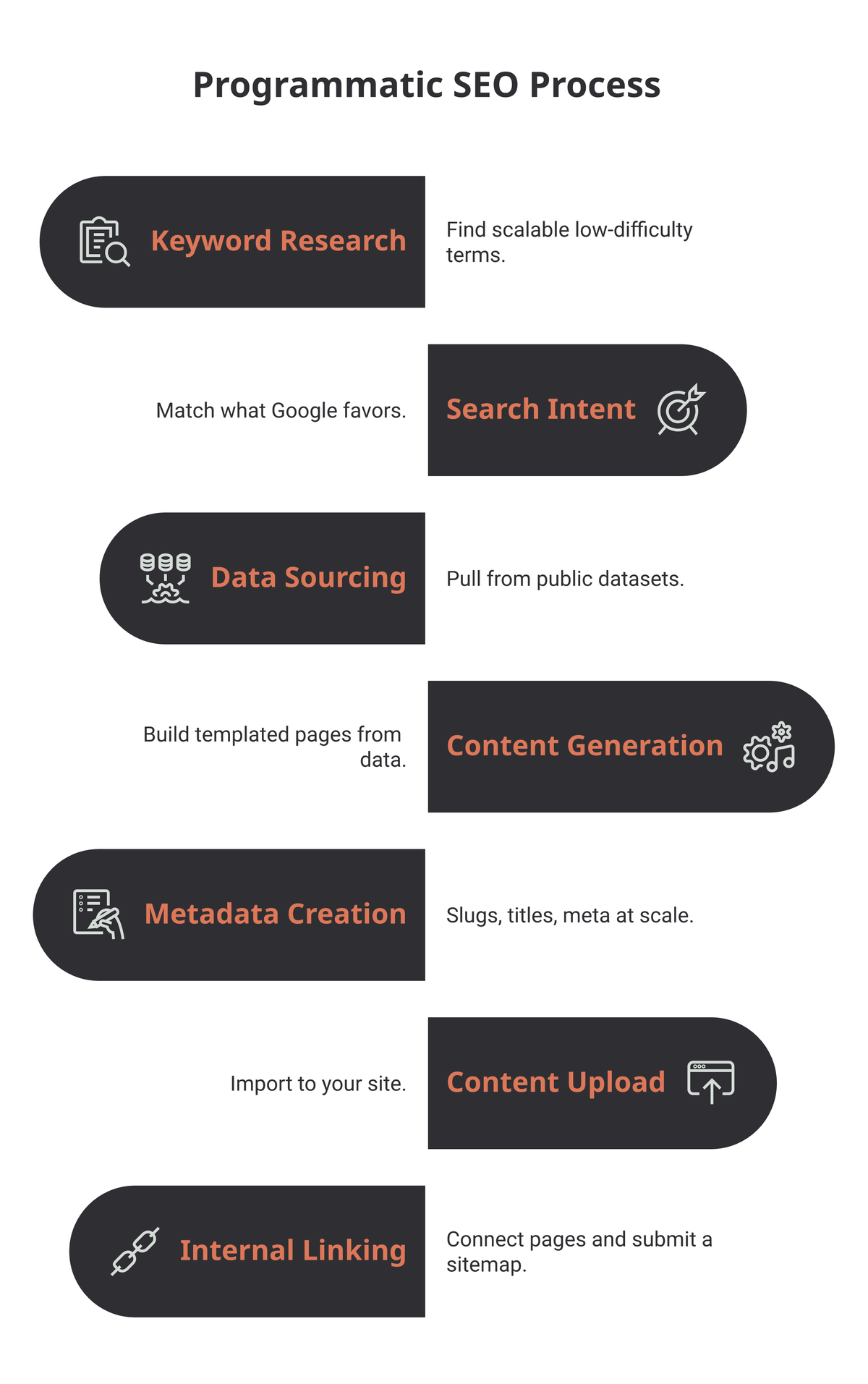
- Keyword Research: Use tools like Ahrefs Keyword Explorer to find scalable keyword sets. Adjust settings to focus on keywords with low difficulty and high relevance.
- Search Intent: Determine what type of content Google favors for your chosen keywords.
- Data Sourcing: Utilize resources like Google Dataset Search, Kaggle, and government databases to find relevant datasets.
- Content Generation: Employ tools like Google Sheets and ChatGPT to generate content based on the sourced data.
- Metadata Creation: Programmatically build metadata, including URL slugs, title tags, HTML code, H1 tags, and meta descriptions.
- Content Upload: Use plugins like WP All Import to upload content to your website.
- Internal Linking and Sitemaps: Optimize internal linking and create an XML sitemap, submitting it to Google Search Console.
Results
The results achieved for the client were remarkable:
- 500+ Pages of Content: Successfully generated through PSEO.
- 38% Increase in Sessions: Reflecting significant traffic growth.
- 1923 Keywords Ranked in Top 10: Demonstrating improved search visibility.
- 800 Organic Backlinks: Gained from high-authority domains.
My Take: What This Means for Solo Publishers
Matt’s case study is one of the cleaner pSEO walkthroughs out there, but here’s what actually transfers to solo publisher reality in 2026.
The “no AI” detail matters more than it looks. His team generated 502 pages with Google Sheets and raw data — no GPT, no automation pipeline — and still pulled 800 referring domains from Microsoft, GitHub, and Google. That result came from the data quality, not the volume. Most solo publishers try to replicate pSEO with generic or recycled datasets and wonder why Google ignores them. The data-driven content approach is the foundation — skip it and the whole pyramid collapses.
AI changes the execution, not the logic. In 2026, nobody is manually formatting 500 rows in Google Sheets. AI-powered programmatic generation — using tools like AirOps, Make.com, or a well-prompted LLM pipeline — cuts production time dramatically. The strategy Matt outlines is still exactly right: seed keyword to template to dataset to upload. You just compress the middle steps with AI now.
The backlink flywheel is real, but only with citable data. Those 800 referring domains didn’t come from volume alone — they came from publishing something editors had a reason to link to. If you want passive link building through data, your dataset needs inherent citation value: original research, aggregated stats, or geographic coverage nobody else has mapped. City plus keyword pages scraped from Wikipedia tables won’t earn anything.
One gap in Matt’s framework: AI search visibility. In 2026, programmatic pages also need to be structured for LLM retrieval, not just Googlebot crawling. LLM-driven SEO now sits on top of traditional pSEO — your templates need clear, extractable answers in the first 100 words, or AI Overviews will surface a competitor instead of you.
For solo publishers, the no-code path is fully viable. WP All Import + Make.com + a solid Google Sheets template gets you to 200+ pages without a developer. Start with a dataset you can uniquely own — local data, niche product specs, historical pricing — and follow Matt’s framework from there. The real barrier isn’t technical skill. It’s finding data worth building on.
The AI-Era Angle: Scale Was the Moat — Now It’s the Commodity
Matt’s case study runs on an assumption that quietly broke between 2024 and 2026: that scale itself is an advantage. Build 502 pages and you carpet the long tail; each thin page catches its own low-competition query and you win by sheer surface area. That logic held when the SERP returned ten blue links per query and the long tail was a million separate searches to be captured one page at a time.
Answer engines collapse that. When a user asks ChatGPT or an AI Overview “best supply-chain tools for [industry],” they don’t get handed 502 indexed pages — the model synthesizes one answer and cites a handful of sources. The long tail of queries still exists, but the long tail of destination pages does not. So programmatic scale stops being a moat the moment retrieval, not indexing, decides who gets surfaced. Ten thousand templated pages are now the single cheapest thing on the internet to produce — a well-prompted LLM pipeline spins them up in an afternoon. When everyone can flood the index, page count is a commodity, not an edge.
What survives the saturation is exactly the detail buried in Matt’s results: the “no AI” / data-quality part. His 502 pages pulled 800 referring domains from Microsoft, GitHub, and Google because the underlying data was worth citing — not because there were 502 of them. That’s the entity/quality gate the AI era enforces with a vengeance. An answer engine picking sources for a synthesized answer runs the same calculus an editor does before linking: is this the most authoritative, most extractable, least-regenerable source for this slice? Proprietary data clears that gate. City-plus-keyword pages scraped from a Wikipedia table — the kind of generic pSEO the model could regenerate from its own training data — do not. The AI doesn’t need to retrieve what it can already produce.
So the pSEO playbook inverts. The old question was “how many pages can I generate?” The 2026 question is “is each page the canonical, citable source for its query — or just one of a thousand interchangeable ones a retriever will skip?” Scale still helps you cover a topic space (and topical coverage is itself a GEO retrieval signal), but only on top of data an answer engine has a reason to cite. The barrier was never technical skill, as the post notes — and it’s even less so now. It’s owning data worth building on. In the saturation era, that’s the whole game.
Action Items
- Keyword Research: Use Ahrefs Keyword Explorer to identify suitable keywords with low difficulty.
- Search Intent Analysis: Determine the type of content preferred by Google for these keywords.
- Data Sourcing: Explore Google Dataset Search, Kaggle, and data.gov for relevant datasets.
- Content and Metadata Creation: Use Google Sheets and ChatGPT to automate the generation of content and metadata.
- Content Upload and Optimization: Use WP All Import for uploading and RankMath for creating and submitting sitemaps.
Conclusion
Programmatic SEO offers a powerful way to scale content creation and enhance search engine rankings through automation. By following the steps outlined by Matt Diggity, businesses can leverage this technique to achieve significant growth in traffic and backlinks.
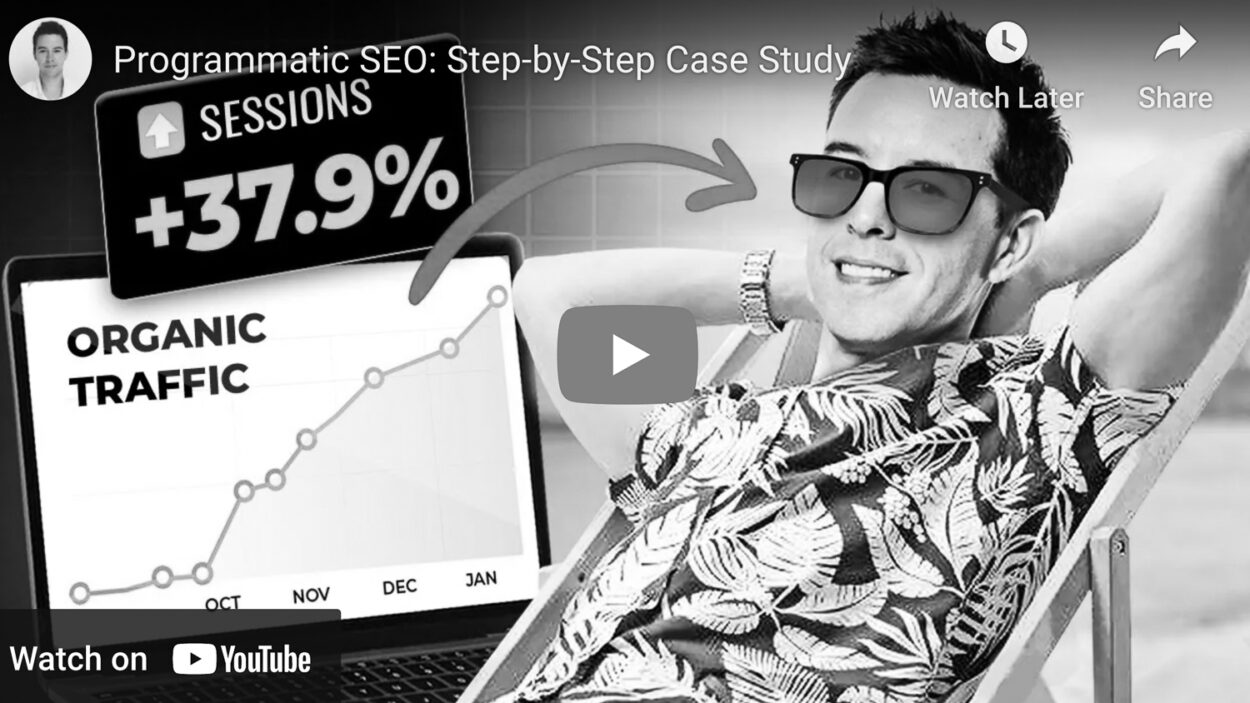
Watch the YouTube video: Programmatic SEO: Step-by-Step Case Study